
Introduction
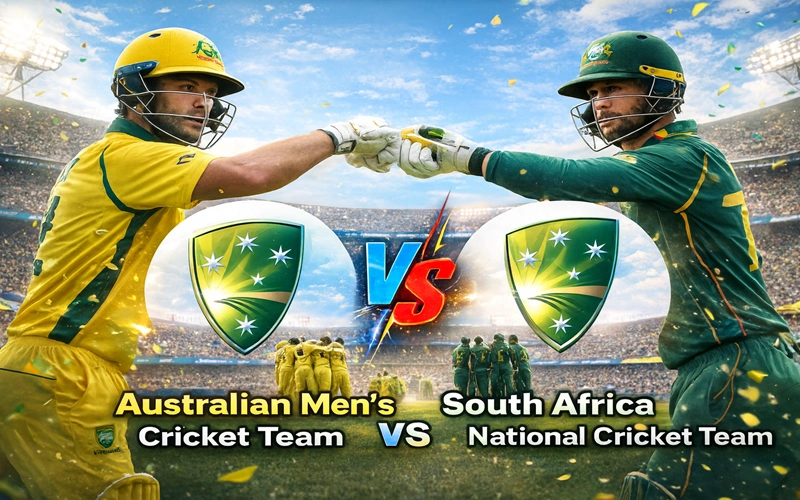
The competition between the Australian men’s cricket team and the South African national cricket team is one of the most revered and fierce in the history of international cricket. Both sides are noted for their aggressive play, strong pace bowling assaults, and a winning attitude that has led to many memorable encounters in all formats. This rivalry is based on skill, strength, and respect for each other, unlike other others that are mostly based on feelings.
Australia and South Africa have played each other in Test cricket, One Day Internationals, and Twenty20 Internationals for more than a hundred years. Their matches have changed the rules and techniques of cricket, and they have made famous players who are still recognized today. This rivalry has always produced great cricket, from timeless Test matches to record-breaking ODI chases.
This article gives a clear and extensive timeline of the rivalry between the Australian men’s cricket team and the South African national cricket team. It talks about the early years, the most important series, the most important events, the most important fights, and the current state of this historic combat. The goal is to give readers clear and useful information on how this rivalry started and why it is still so important in world cricket.
The Beginning of a Rivalry (1902–1935)
The first official cricket match between Australia and South Africa took place in the early 1900s. The Proteas’ long and hard path in international cricket began when South Africa visited Australia for the first time in 1902–03.
Australia was already a strong cricketing nation in these early years, but South Africa was still working on its cricketing framework. Because of this, Australia won most of the early Test series. But these tours were very important for South Africa’s advancement since they gave the squad a chance to play against strong opponents and in tough conditions.
One of the most important things about this time was that Test cricket was seen as the best format. There were multiple days of matches, and the players had to pay close attention to their technique, patience, and endurance. Australian batters generally took charge of the game, while South African bowlers had to work hard to make an impression on pitches they weren’t used to.
Even though they lost a lot, South Africa learned a lot and slowly built a strong team. The difference between the two teams had started to close by the 1930s, which laid the way for more even matches in the years to come.
Growth via competition and respect for each other (1935–1970)
The competition got more intense from the mid-1930s until the 1970s. South Africa got a lot better and created good players who could compete with Australia on similar grounds. During this time, the series saw close matches, great individual performances, and teams that respected each other more and more.
Australia kept winning, especially at home, but it was getting harder and harder to beat South Africa. Their fast bowlers and technically sound batsmen started to challenge Australia’s dominance, which led to a number of hard-fought series.
Cricket also became more organized and professional at this time. Better scheduling, better preparation of the field, and more media attention all helped make international matches more popular. People now saw Australia vs. South Africa matches as big events, especially in Test cricket.
But this time of competitive progress was cut short by political events that would soon have a big effect on South African cricket.
Long break and isolation of South Africa (1970–1991)
One of the most important parts of this rivalry is how long South Africa was out of international cricket because of apartheid. From the early 1970s until 1991, South Africa was not allowed to play in formal international cricket matches, even against Australia.
This hiatus stopped what had become a very competitive contest. Australia kept playing and getting better, while South Africa’s rise on the world stage stopped. A lot of excellent South African players missed out on the chance to play at the highest level while they were at their best.
During this time, Australian cricket lost a formidable rival. Playing against South Africa was always a test of skill and spirit, and their absence was felt in the world of cricket.
Fans and players alike were excited to see this rivalry come back when South Africa eventually returned to international cricket in the early 1990s.
The Revival Era and More Competition (1991–1999)
When South Africa started playing international cricket again in 1991, the rivalry with Australia started up again. The enthusiasm was instant since both teams were powerful, competitive, and ready to take over in the new era.
There were a lot of great games in the 1990s, especially One Day Internationals. South Africa swiftly became one of the most reliable ODI sides, while Australia was rebuilding and trying out different combinations.
The 1999 World Cup semifinal between Australia and South Africa, which finished in a stalemate, was one of the most important events of this time. Australia moved on to the final because they had a better Super Six record, whereas South Africa’s hopes were dashed. This encounter is still one of the most talked-about games in cricket history, and it made the rivalry more emotional.
At the end of the decade, both teams were known as top cricketing nations that could beat anyone on their day.
Dominance, Records, and Famous Series (2000–2008)

The rivalry between Australia and South Africa was at its best in the early 2000s. Australia was at its best, with a strong group of batsmen and bowlers that made it the best team in the world. South Africa, on the other hand, was one of the few teams that could routinely beat Australia.
During this time, test series were very competitive and often very close. There was high-quality fast bowling, aggressive batting, and smart captaincy in the matches. Australia was clearly the better team, but South Africa earned respect for their toughness and battling spirit.
The competition becomes much more intense in One Day Internationals. In 2006, South Africa chased down a record-breaking target against Australia in an ODI, which is one of the most famous moments. People thought differently about what was possible in limited-overs cricket after this game, which is now hailed as one of the best ever.
This time period solidified the rivalry as one based on skill and new ideas, with both teams pushing the limits of the sport.
Battles that were fair and changing momentum (2009–2015)
The balance of power between Australia and South Africa started to change in 2009. South Africa had a good run in Test cricket, including winning series in Australia that were historic. These wins were important since it has always been very hard for visiting teams to win in Australia.
South Africa was able to play well in all conditions of their disciplined bowling assaults and solid batting lineups. Australia was still competitive, but they were going through a transition period where they tried out new players and ways of leading.
During this time, One Day Internationals and T20 Internationals were about the same level. Both sides did well in their bilateral series, and matches were often quite close.
This time period showed how deep and flexible both sides were and added to the rivalry’s reputation for generating great cricket.
Modern Era and Rivalry Across Many Formats (2016–2020)

The rivalry in the current age has been shaped by all three types of games. Test matches are still the most important games, but ODIs and T20Is have made them faster, more exciting, and more popular around the world.
The 2018 Test series between Australia and South Africa was one of the most talked-about series in recent memory. It was full with strong competitiveness and controversy. The series got a lot of attention throughout the world and had long-term effects on Australian cricket.
Even though there were problems off the field, the quality of cricket stayed good. South Africa was still a tough opponent at home, but Australia stayed strong on pitches they were used to.
During this time, new talents appeared on both sides, which kept the rivalry interesting and fierce.
Recent Years and Current Status (2021 to Now)

Australia and South Africa have played each other in key tournaments and bilateral series in recent years. The rivalry has changed as players’ styles, fitness levels, and strategies have changed.
Australia has become more consistent in all formats, while South Africa has focused on rebuilding and developing young players. People still pay a lot of attention to matches between the two sides, especially in World Cups and Test series.
Even while the competition is still fierce, the focus on professionalism and sportsmanship has made people respect each other more. Fans all over the world are still excited about each new chapter in this historic chronology.
Overview of the Head-to-Head Timeline
| Era | Key Features | Overall Effect |
|---|---|---|
| 1902–1935 | Australia’s early dominance | Set the stage for rivalry |
| 1935–1970 | More competition | Respect for each other grows |
| 1970–1991 | South Africa not there | Rivalry stopped |
| 1991–1999 | Drama in the World Cup and Revival | Added emotional depth |
| 2000–2008 | Australia’s best years | Famous games and records |
| 2009–2015 | Competitions that are fair | Change in Test dominance |
| 2016–2020 | Arguments and intensity | Attention from around the world |
| 2021 to now | Modern competition in many formats | Still important |
Main Ideas of the Rivalry
-
Fast bowling has always been important, and both teams have had world-class speed attacks. Mental strength and a competitive spirit are just as crucial, since matches regularly test players’ ability to bounce back.
-
Another important idea is adaptability. Both sides have proved that they can change their plans based on the situation and the format. This flexibility has kept the contest exciting and full of surprises.
-
Finally, respect is still a key trait. Even though the competition is tough, both teams recognize each other’s talents and contributions to the game.
Impact on Cricket Around the World
This rivalry has had a big effect on cricket around the world. Matches between Australia and South Africa have led to several new tactics, fitness standards, and performance benchmarks.
People often talk about the best moments in cricket history by bringing up famous games from this rivalry. Kids in both countries grow up watching these games and want to play at the greatest level.
The rivalry also makes cricket popular all around the world, drawing in big crowds and keeping people of all ages interested.
Conclusion
The rivalry between the Australian men’s cricket team and the South African national cricket team is more than just victories and losses. It tells a story of growth, strength, change, and excellence. This rivalry has always made cricket better, from early supremacy and long breaks to modern-day fights in many formats.
As both teams get better, the future will bring more exciting games and important moments. For fans and followers of the sport, this rivalry is still a sign of high-quality cricket and a strong desire to win.
Read More:-India vs Pakistan Cricket Timeline: Historic Rivalry